- Home
- Increase Productivity at Work
- How to Stay Consistent
How to Stay Consistent as a Small Business Owner | Strategies to Achieve Success!

One of the biggest challenges small business owners face is how to stay consistent, even though consistency plays a vital role in long-term success.
Many business owners know what they should be doing, but struggle to follow through consistently. This usually isn’t due to a lack of motivation or discipline. More often, it comes down to a lack of clarity, misaligned routines, and trying to do too much without the right structure.
In this article, you’ll learn how to stay consistent by building routines and habits that support not just your business, but your energy, focus, and life as a whole...so progress becomes sustainable rather than exhausting.
The Key Ingredient to Achieve Success
Before we talk about strategies, it’s important to step back and look at what success actually requires...especially for small business owners.
One of the key ingredients to achieving success is being able to show up consistently as your best self.
This doesn’t mean being perfect or operating at full capacity every single day. It means having the clarity, energy, and focus to move forward in a way that’s sustainable over time.
Showing up as your best self includes:
- Being clear on what you want to achieve
- Feeling happy and fulfilled
- Experiencing a sense of accomplishment rather than constant overwhelm
- Maintaining healthy relationships with the people around you
- Having the energy and focus to work on what truly matters
To achieve this, you need to take a holistic approach, taking into account the following key areas:
- Business: working efficiently and optimizing the use of your time.
- Personal life: staying organised so things don’t fall through the cracks and create unnecessary stress.
- Relationships: intentionally making time for your relationships, because when those start to suffer, it becomes much harder to stay focused, motivated, and consistent in your work.
- Self-care: We simply can’t show up as our best selves if we’re not eating well, exercising, or getting enough rest.
All of these areas are interconnected. When one area is neglected, it affects the others, and over time, it impacts how successful and consistent you’re able to be.
The Importance of Routines and Habits When Learning How to Stay Consistent
When people try to figure out how to stay consistent, they often rely heavily on motivation and self-discipline. That can work in the short term, but it’s exhausting and unreliable.
Motivation comes and goes...willpower runs out.
Routines and habits change that.
Once a habit is formed, you no longer have to rely on motivation in the same way. The behaviour becomes more automatic. It feels easier, more natural, and far less mentally demanding.
This is why routines are so powerful. They’re create structure that allows you to consistently invest time and energy into:
- Your business
- Your personal life
- Your relationships
- Your wellbeing
When your routines support all of these areas, staying consistent stops feeling like a struggle—and success becomes far more sustainable.

Why Small Business Owners Struggle to Stay Consistent
If consistency is so important, why does it feel so difficult to maintain? For most small business owners, struggling to stay consistent isn’t a personal failure...it’s a result of unclear priorities, competing demands, and routines that don’t fully support their goals.
Understanding the real reasons consistency breaks down is the first step toward fixing it and creating a more sustainable way of working.
Lack of Clarity
One of the biggest reasons is a lack of clarity.
There are countless strategies, frameworks, and “gurus” out there, all offering different advice. It’s easy to start working on one approach, then hear someone say, “This worked really well for me,” and switch direction.
Over time, you end up bouncing between ideas without making meaningful progress on any of them.
Juggling Too Much
Small business owners wear many hats. You’re often the CEO, manager, marketer, service provider, and admin team all at once.
Many people also start their business while working full-time, raising a family, running a household, and managing personal commitments. Trying to handle everything simultaneously can be overwhelming—and overwhelm makes staying consistent incredibly difficult.
Building a Business Is Hard
Despite what you may hear, building a business isn’t easy. It requires sustained effort, often with very little immediate reward.
When progress feels slow and results don’t show up straight away, it’s hard to keep going consistently.
Misaligned Routines and Habits
Another major reason consistency breaks down is misalignment.
Many business owners are busy all day, but they’re not consistently working on the things that actually move the business forward. When your routines don’t support your goals, learning how to stay consistent in business feels like an uphill battle.
Alignment between your goals, routines, and habits is what makes consistency achievable.
How to Build Routines for Success: A Practical Framework to Stay Consistent
To help clients build routines that actually stick, I use a simple three-step framework.
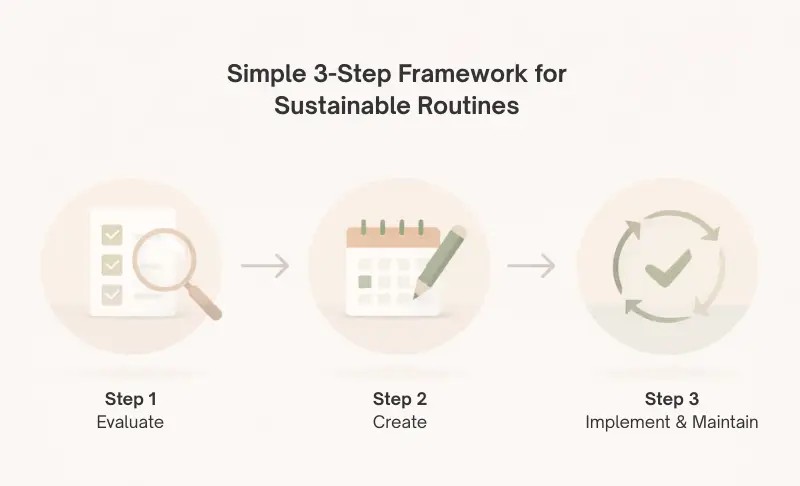
Step 1: Evaluate
Start by stepping back and evaluating your current situation.
Ask yourself:
- What do I want to achieve?
- Why is this important to me?
- How am I going to achieve it?
Next, review your current routines and habits. Are they helping you move toward your goals, or holding you back?
Before making changes, identify your non-negotiables...the things that must stay in your routine, such as:
- Dedicated time to work on your business and learn new skills
- Time to manage personal affairs
- Family time
- Self-care, including daily movement and downtime
Everything else should be built around these priorities.
Step 2: Create a Routine Aligned with Your Goals
Once you’re clear on your goals, break them down into manageable actions...things that need to happen daily, weekly, monthly, or yearly.
Then look at your existing routine and decide where these activities fit.
When creating your routine:
- Protect your non-negotiables
- Intentionally make time for business, personal life, relationships, and self-care
- Schedule important tasks when your energy is highest
- Keep your routine flexible
Instead of assigning tasks to exact times, use task blocks that can move around. This flexibility is essential when every day looks different and is key to staying consistent long term.
Step 3: Implement Your Routine and Stick to It
Implementation is where consistency is built.
- Keep your routine visible
- Introduce new routines gradually
- Start small and build over time
- Practise regularly until actions become habits
New habits take time to form, so patience and repetition are critical.
Key Strategies to Stay Consistent Without Relying on Motivation
Building routines is only part of the equation. To stay consistent over time, you also need simple strategies that help you track progress, stay motivated, and avoid falling off track when things get busy or life gets in the way.
The following practices will help you maintain momentum and turn consistency into a long-term habit rather than a short-lived effort.
Monitor Your Progress
Review your progress regularly. If a goal isn’t being met, adjust the goal or tweak your routine rather than abandoning it altogether.
Use a “Done List”
Most people focus only on to-do lists. Over time, this creates the feeling of being constantly busy without making progress.
A done list helps you see what you’ve actually accomplished, reinforcing progress and motivating you to keep going.
Celebrate Your Achievements
When planning your goals, include small rewards for reaching milestones. Acknowledging progress...no matter how small...supports consistency and momentum.
Build in Support and Accountability
New habits can take weeks or even months to form, and the early stages are when people are most likely to fall off track.
Support from like-minded people, an accountability partner, or a coach significantly increases your chances of staying consistent and achieving long-term success.
BOTTOM
LINE
Learning how to stay consistent isn’t about motivation, willpower, or doing everything perfectly.
It’s about clarity, alignment, and building routines that support both your goals and your life.
When your routines are aligned with what truly matters, consistency becomes easier, progress becomes visible, and success becomes sustainable.
Start small. Stay flexible. And keep showing up for the priorities that move you forward.
Popular Articles
Explore some of our most popular articles designed to help you build better habits, stay organized, and improve productivity, both at work and in everyday life.
- How to Increase Productivity at Work
- Habits of Organized People
- Self-care Tips
- Getting Organized at Work - 4 Essential Tips for Success
- Tips for Organizing Your Home in 4 Easy Steps
Share this with others by clicking the icons below!


Recent Articles


-
How to Stay Consistent as a Small Business Owner
Jan 20, 26 05:46 PM
 Struggling with consistency? Learn how to stay consistent by building routines and habits that support your business, energy, and long-term success.
 -
Organization Strategies for ADHD that Work for Small Business Owners
Dec 21, 25 07:36 AM
 Organization strategies for ADHD made simple. Discover practical, evidence-based systems for small business owners to stay organized without overwhelm.
 -
AI Tools for Small Business: Save Time & Reduce Admin
Dec 15, 25 03:03 PM
Discover how AI tools for small business can save time, reduce admin, and support simple workflows...without losing the human touch or adding overwhelm.