- Home
- Get Started
- Organization Strategies for ADHD
Organization Strategies for ADHD: A Practical Guide for
Small Business Owners

Finding organization strategies for ADHD that actually work
can feel frustrating—especially if you’re running a small business.
You’re managing ideas, tasks, deadlines, and decisions with little external structure. Some days you’re focused and productive. Other days, everything feels overwhelming or stuck.
If staying organized feels harder for you than it seems to be for others, it’s not a personal failure.
Research shows that traditional organization systems are often ineffective for adults with ADHD because they rely on executive function skills—like working memory, planning, and time awareness—that ADHD directly impacts.
This guide breaks down evidence-based organization strategies for ADHD, specifically tailored for small business owners, so you can build systems that support how your brain works—not fight against it.
In this article, you will learn:
- Why organization feels harder with ADHD—and why it’s not a personal failure
- Why traditional organization systems don’t work for ADHD
- What actually makes organizational strategies effective for ADHD brains
- Evidence-based organization strategies for ADHD that actually work
- How to build ADHD-friendly organization systems that stick
Why Adults With ADHD Struggle With Organization
ADHD is a neurodevelopmental condition that affects executive
function—the mental skills responsible for managing tasks, time, and attention.
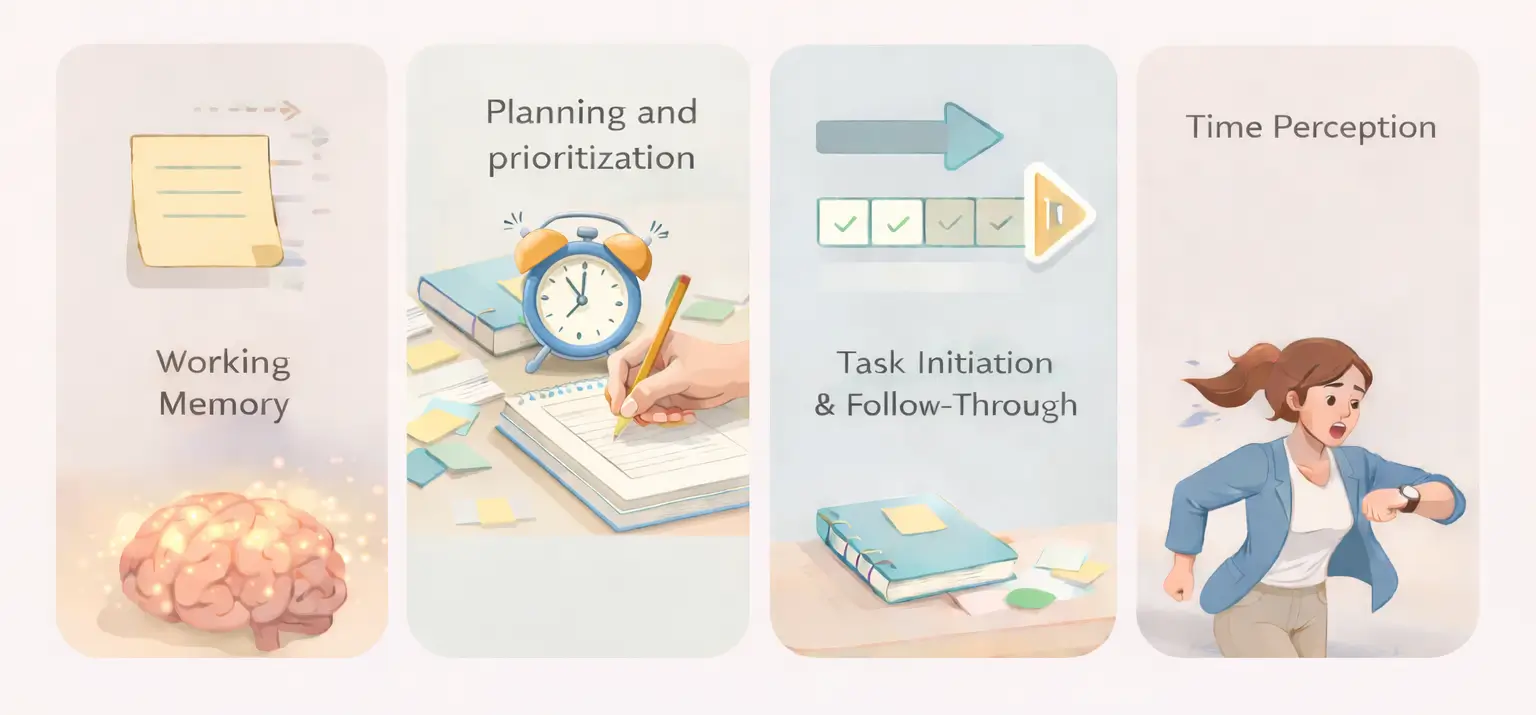
These include:
- Working memory: the brain’s ability to hold information in mind temporarily and use it to complete a task. You can think of this as your brain’s mental sticky note or scratchpad.
- Planning and prioritization: the ability to decide what matters most, break work into steps, and sequence tasks effectively.
- Task initiation and follow-through: difficulty starting tasks, avoiding procrastination, and carrying tasks through to completion—even when they’re important.
- Time perception (“time blindness”): difficulty sensing the passage of time, estimating how long tasks will take, or noticing how close deadlines really are.
For small business owners, these challenges are often amplified. There’s no built-in structure, external accountability, or predefined priorities…you have to create your own schedules, systems, and routines.
This frequently leads to:
- mental overload
- difficulty deciding what to work on next
- feeling behind, despite consistent effort
Most traditional organizational systems are not designed for
ADHD brains, which is why staying organized can feel so frustrating, even when
you’re working hard.
Why Traditional Organization Systems Don’t Work for ADHD
Many popular productivity and organization systems assume
you will:
- remember to check planners consistently
- estimate time accurately
- follow plans once they’re created
- stay motivated without external accountability
Research shows that adults with ADHD usually know organizational strategies, but struggle with persistence and consistent use over time
When a system only works on high-focus days, it’s not an
effective organization strategy for ADHD.
What Makes Organization Strategies for ADHD Effective?
Effective organization strategies for ADHD are designed to reduce
cognitive load, the amount of mental effort your brain is using at any given
moment. In simple terms, cognitive load is how “full” your mental capacity is
while you’re thinking, deciding, remembering, or taking action.
ADHD-friendly organization systems are designed to:
- Reduce decisions: By using templates, routines, and defaults, you limit the number of choices you have to make each day, which lowers mental effort and decision fatigue.
- Externalize memory: Instead of relying on your brain to remember everything, you use lists, visual cues, and checklists to hold information for you.
- Simplify systems: Fewer tools and fewer steps make systems easier to maintain...especially on low-energy or low-focus days.
- Increase visibility: When something is out of sight, it’s often out of mind. Visible systems reduce the risk of tasks, priorities, or deadlines being forgotten.
As a general rule of thumb: if a system requires constant thinking to maintain, it’s increasing cognitive load, not reducing it.
Organization Strategies for ADHD That Actually Work
Below are practical, ADHD-friendly organization strategies that help reduce mental overload, make follow-through easier, and still work on low-focus days.
1. Use One Central Capture System
I recommend starting with a single, low-friction “inbox”—not
a complex system.
For example:
- One digital notes app, task manager, or paper notebook
- Easily accessible from your phone or desk
- Used only for capturing, not sorting in the moment
Here’s how it works in real life:
- An idea pops into your head → you immediately add it to your capture inbox
- A task comes up during a call → you write it down in the same place
- A deadline is mentioned → you capture it first, without deciding where it belongs yet
You don’t stop to prioritize, categorize, or schedule. That
comes later, during a short, planned review.
2. Make Priorities Visual
ADHD brains often struggle to prioritize internally. When
everything lives in your head, tasks tend to feel equally urgent, equally
important, or equally overwhelming. This can lead to procrastination,
task-hopping, or freezing altogether.
Visual priority systems work because they move prioritization out of your head and into your environment.
A very effective strategy is the Daily “Top 3” Priority List
Instead of a long to-do list, choose no more than three
priorities for the day.
- Write your Top 3 tasks on a sticky note, index card, or at the top of your planner.
- Place it somewhere you’ll see frequently—your desk, monitor, or notebook cover.
- Everything
else goes on a secondary list. You’re allowed to work on it only after
the Top 3 are done or consciously paused.


3. Define Clear Next Actions
Large or vague tasks often trigger avoidance for ADHD
brains. When a task isn’t clearly defined, your brain has to do extra work to
figure out where to start, which increases cognitive load and makes
procrastination more likely.
Breaking work into clear, concrete next actions is one of the most research-supported organization strategies for ADHD. A “next action” is the very next physical step you can take—something that could be done without further thinking.
- Instead of: “Work on website”
- Use: “Write homepage headline”
Small, specific steps reduce resistance and make starting
easier. Momentum follows action…not motivation.
4. Use Time Awareness Tools (Not Perfect Schedules)
Time blindness is a common ADHD challenge. It makes it
difficult to accurately estimate how long tasks will take or to feel
deadlines approaching until they’re suddenly urgent.
Effective organization strategies for ADHD focus on making time visible, rather than trying to create perfect schedules.
Helpful time awareness tools include:
- Visual timers
- Calendar time-blocking
- Buffer time between tasks
- Short planning horizons
These tools externalize time so you don’t have to track it
mentally.
5. Build Short Reset Routines
Many adults with ADHD wait until everything feels
unmanageable before trying to get organized again. By that point, the system
feels overwhelming, and burnout is often already setting in.
Research-backed approaches show that small, repeatable reset routines are far more effective than occasional, full-scale overhauls.
Here are some examples of helpful reset routines you can use:
- daily planning check-ins
- weekly reviews
- end-of-day shutdowns
These routines reduce decision fatigue, create a sense of control, and make it much easier for you to restart, without needing to “fix everything” at once.
Ready to Build ADHD-Friendly Organization Systems That
Actually Stick?
Reading about organization strategies for ADHD is a powerful
first step, but applying them consistently in real life, especially in a small
business, can still feel challenging without support.
That’s why I’m currently planning a live, practical workshop for small business owners with ADHD (or ADHD-like challenges) who want systems that work on imperfect days, not just ideal ones.
Live Workshop: ADHD-Friendly
Organization for Small Business Owners
A practical workshop focused on reducing overwhelm,
improving follow-through, and creating systems that fit how your brain works.
This workshop is being designed to help you:
- Build simple organization systems that reduce cognitive load
- Set up one central capture and planning system you’ll actually use
- Turn vague goals and projects into clear, doable next actions
- Create visual priorities so you always know what to work on next
- Design short reset routines that make it easy to restart—without guilt
No rigid schedules. No overcomplicated tools. No “just try
harder” advice.
Join the Priority Waitlist
I’m opening a priority waitlist so I can shape the
workshop around the real challenges small business owners with ADHD face.
By joining the waitlist, you’ll:
- Be the first to know when registration opens
- Get early access details
- Have the opportunity to influence the workshop content
If you’re ready to stop fighting your brain and start building organization systems that support it, join the waitlist, and I’ll keep you updated as soon as the workshop is ready.
BOTTOM
LINE
You don’t need more willpower.
You don’t need to try harder.
You need organization strategies for ADHD that align with how your brain works...especially if you’re running a business.
If you’d like guided support applying these strategies in your own business, I’m currently planning a practical, ADHD-friendly workshop for small business owners.
Join the priority waitlist to be the first to know when it opens and to help shape the content around what you need most.
For additional, practical steps to organize different areas of your life, see how to organize your life in 3 easy steps.
References
- Impact of psychometrically defined deficits of executive functioning in adults with attention deficit hyperactivity disorder — Biederman et al. (2006)
- Reduced organizational skills in adults with ADHD are due to deficits in persistence, not in strategies — Durand et al. (2020)
- Clinical implications of the perception of time in attention deficit hyperactivity disorder (ADHD): A review — Ptacek et al. (2019)